

Client
Le Nettoyeur
Année

2022

Le site internet

Le client

Le Nettoyeur est une blanchisserie et Pressing de qualité basé à Abidjan avec des ateliers à la pointe de la technologie pour un rendu d’excellence.
Son service est constitué de : collecte, nettoyage et livraison sous 48H.

Le projet

La mission de Comfordev était de concevoir un site web qui épouserait la vision de l’entreprise et qui lui servirait de vitrine institutionnelle. Concevoir un espace où les prestations proposées par Le Nettoyeur seront visibles par les prospects et clients.

Understanding Verification Processes in Betting Through Betlama’s Analysis

The betting industry has undergone significant transformation over the past two decades, with verification processes becoming increasingly sophisticated and central to operations. What began as simple identity checks has evolved into complex systems designed to protect both operators and bettors while ensuring regulatory compliance. Betlama’s comprehensive analysis of these verification mechanisms reveals a landscape where security, user experience, and legal requirements intersect in ways that fundamentally shape how modern betting platforms operate. Understanding these processes is essential for anyone seeking to navigate the contemporary betting environment effectively.

The Historical Evolution of Betting Verification Standards

Verification in betting has its roots in the early 2000s when online gambling platforms first emerged as viable alternatives to traditional bookmakers. Initially, these processes were rudimentary, often requiring little more than an email address and payment method. However, the landscape changed dramatically following several high-profile incidents involving money laundering and underage gambling between 2005 and 2010. Regulatory bodies across Europe, particularly in the United Kingdom and Malta, began implementing stricter Know Your Customer (KYC) requirements that fundamentally altered industry standards.

The implementation of the Fourth Anti-Money Laundering Directive in the European Union in 2017 marked a watershed moment for verification protocols. This legislation mandated enhanced due diligence measures, requiring betting operators to verify customer identities through government-issued documentation, proof of address, and in some cases, source of funds verification. Betlama’s research indicates that these regulatory changes increased the average verification completion time from approximately 15 minutes to between 24 and 72 hours, depending on document quality and operator efficiency.

By 2020, the integration of artificial intelligence and optical character recognition technology began streamlining these processes significantly. Automated systems could now analyze identity documents in real-time, cross-referencing information against multiple databases to detect fraudulent submissions. This technological advancement reduced verification times while simultaneously improving accuracy rates, with leading platforms achieving fraud detection rates exceeding 98 percent according to industry data compiled by Betlama’s analytical team.

Contemporary Verification Methods and Their Implementation

Modern betting platforms employ a multi-tiered verification approach that balances security requirements with user experience considerations. The primary tier typically involves document verification, where users submit photographs or scans of government-issued identification such as passports, driver’s licenses, or national identity cards. Advanced platforms utilize biometric verification, requiring users to submit selfies or undergo liveness checks to confirm that the person creating the account matches the submitted documentation.

Address verification constitutes the second critical component, traditionally accomplished through utility bills, bank statements, or government correspondence dated within the previous three months. Betlama’s analysis reveals that approximately 23 percent of initial verification attempts fail due to address documentation issues, with expired documents and name mismatches being the most common problems. Progressive operators have begun accepting digital bank statements and integrating with credit reference agencies to expedite this process, reducing failure rates by nearly 40 percent.

The emergence of no-id verification sportsbooks represents an interesting development within jurisdictions that permit alternative verification methods, though these platforms still maintain robust anti-fraud measures through payment verification and behavioral analysis systems. Payment method verification serves as an additional security layer, with platforms requiring users to confirm ownership of credit cards, e-wallets, or bank accounts used for transactions. This process typically involves small test deposits or requiring users to submit photographs of their payment cards with sensitive information partially obscured.

Enhanced due diligence procedures activate when users exceed certain deposit or withdrawal thresholds, typically ranging from €2,000 to €10,000 depending on jurisdiction and operator risk assessment. These procedures may include source of wealth verification, requiring users to demonstrate the legitimate origin of their funds through employment contracts, business ownership documentation, or inheritance papers. Betlama’s data indicates that approximately 8 percent of active bettors encounter enhanced due diligence requirements annually, with completion rates varying significantly based on the clarity of operator communication regarding required documentation.

Regulatory Frameworks and Jurisdictional Variations

Verification requirements vary substantially across different licensing jurisdictions, creating a complex patchwork of standards that operators must navigate. The United Kingdom Gambling Commission maintains some of the industry’s strictest requirements, mandating verification completion before first withdrawal and implementing additional checks for customers showing potential signs of problem gambling. These regulations, strengthened in 2020, require operators to conduct affordability assessments for customers losing £1,000 or more within 24 hours or £2,000 over 90 days.

Malta Gaming Authority regulations, which govern a significant portion of European-facing operators, require identity verification within 72 hours of account registration or before the first withdrawal, whichever occurs first. This framework allows users to begin betting with smaller deposits before completing full verification, balancing accessibility with security concerns. Betlama’s comparative analysis demonstrates that Malta-licensed operators process verification requests approximately 30 percent faster than UK-licensed counterparts, primarily due to differences in required documentation depth.

Curacao-licensed operators, serving markets with less stringent regulatory oversight, typically implement more flexible verification standards, though reputable platforms still maintain robust KYC procedures to prevent fraud and maintain payment processor relationships. The Gibraltar Gambling Commission occupies a middle ground, requiring comprehensive verification but permitting more technological solutions such as electronic identity verification systems that cross-reference government databases directly. These jurisdictional differences significantly impact user experience, with average time-to-first-bet varying from minutes to several days depending on licensing authority requirements.

Technological Innovation and Future Verification Trends

Blockchain technology and decentralized identity solutions represent the frontier of verification innovation in betting. Several platforms have begun experimenting with self-sovereign identity systems, where users maintain control of their verification credentials and can share them across multiple platforms without repeated document submission. Betlama’s forward-looking analysis suggests that these systems could reduce industry-wide verification costs by up to 60 percent while improving user privacy and data security.

Artificial intelligence continues advancing verification capabilities through sophisticated pattern recognition and anomaly detection. Machine learning algorithms now analyze hundreds of data points including device fingerprinting, betting patterns, login locations, and transaction behaviors to identify potentially fraudulent accounts or problem gambling indicators. These systems operate continuously in the background, providing dynamic risk assessment that adapts to emerging threats far more effectively than static rule-based systems.

Biometric verification is expanding beyond facial recognition to include voice authentication and behavioral biometrics that analyze typing patterns, mouse movements, and navigation behaviors unique to individual users. These passive authentication methods enhance security without creating friction in the user experience, addressing one of the primary tensions in verification process design. Industry projections analyzed by Betlama indicate that biometric verification adoption will exceed 75 percent among major operators by 2026, driven by both security improvements and user preference for streamlined processes.

The integration of instant bank verification services represents another significant trend, allowing users to complete identity and address verification simultaneously through secure bank account connections. This approach leverages the extensive KYC processes already completed by financial institutions, eliminating redundant verification steps. Early adoption data shows completion rates exceeding 90 percent with average processing times under five minutes, suggesting this method may become the industry standard for markets where banking infrastructure supports such integration.

Understanding verification processes in betting reveals an industry balancing competing demands for security, regulatory compliance, and user experience. Betlama’s analysis demonstrates that while verification requirements have become more comprehensive and technologically sophisticated, they serve essential functions in protecting users, preventing fraud, and maintaining the integrity of betting markets. As technology continues evolving and regulatory frameworks mature, verification processes will likely become both more robust and less intrusive, achieving the optimal balance that has long eluded the industry. The future points toward seamless, secure systems that protect all stakeholders while minimizing friction for legitimate users.

Mise en avant

Slider

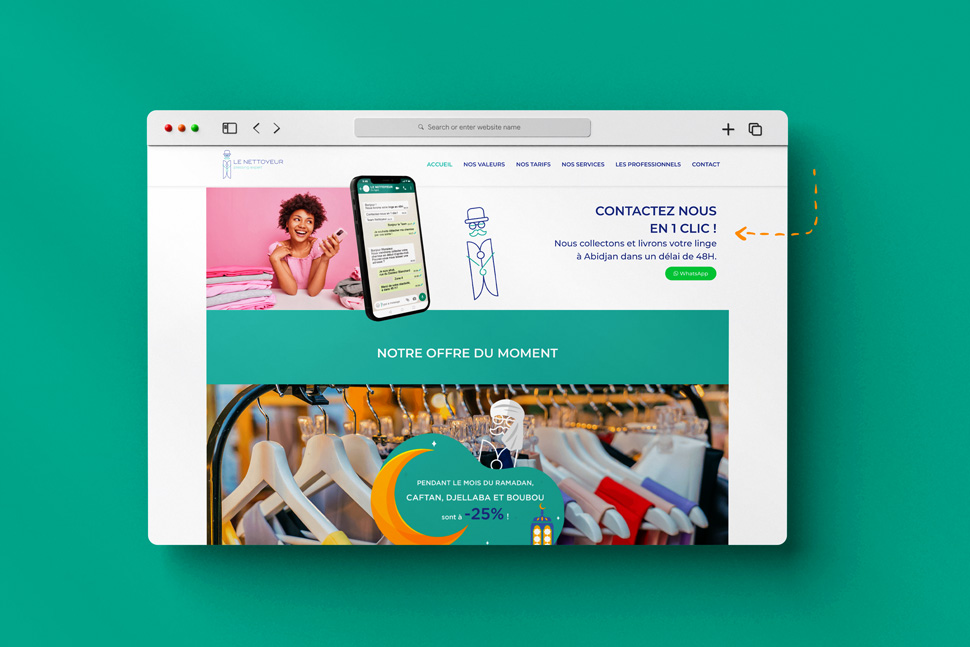
Le slider permet à l'entreprise Le Nettoyeur de présenter son actualité, ses services et actions au travers de grandes bannières animées et interactives. Il a aussi pour but principal, de capter l’attention de l’internaute dès son arrivée sur le site web.
Ergonomique

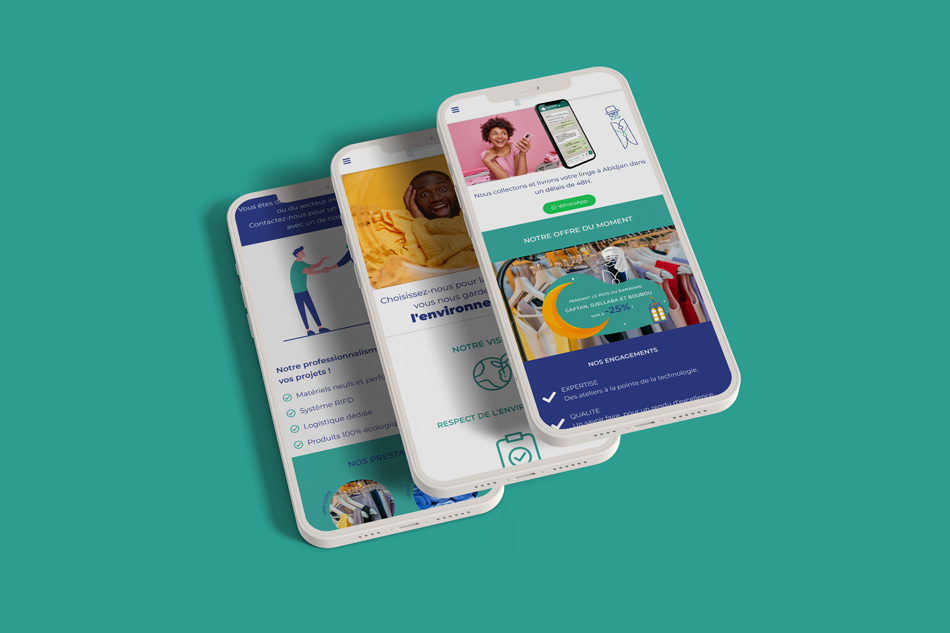
Site Responsive Design

Le site s’ajuste automatiquement dès l’affichage d’une page web sur différents écrans, tel que (PC, Smartphone ou Tablette). Cette technique de conception répond à un besoin des utilisateurs, celui de se connecter aisément sur le web depuis un appareil mobile.

Accessibilité

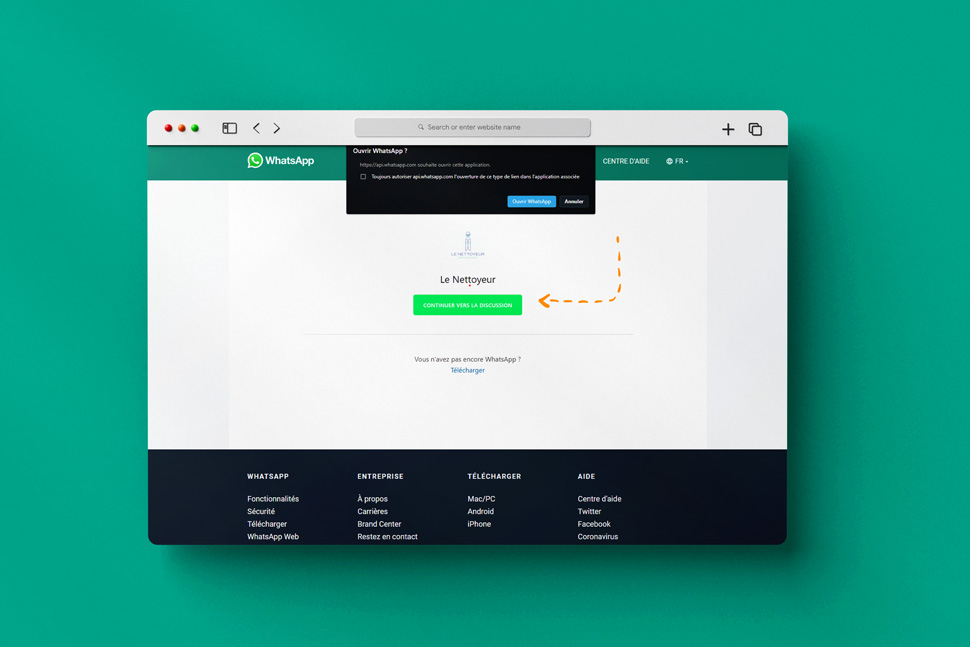
Accès au Whatsapp Business du pressing en un clic

Pour un service de qualité, l'accès à Whatsapp Business permet de faciliter la communication entre le client et l'entreprise.
Whatsapp étant un réseau social couramment utilisé, le client ou l’internaute peut, depuis le site web discuter étroitement avec la laverie. Passer une information ou souscrire à leur service.
Instantanéité

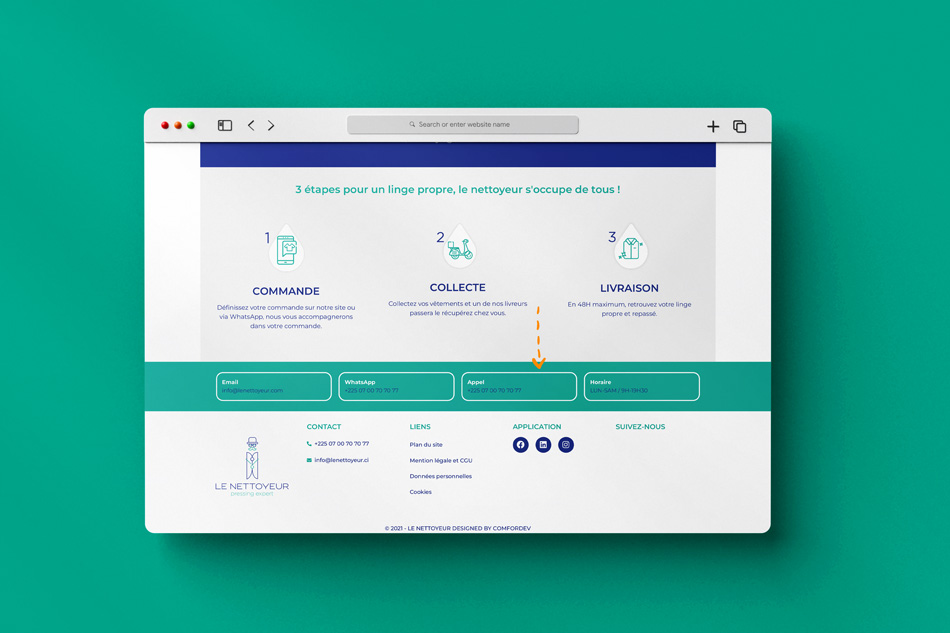
Lancement d’un appel téléphonique par simple clic sur le numéro de téléphone

Pour faciliter la communication entre Le Nettoyeur et ses clients, Comfordev a mis à disposition un système qui permet en un clic de rentrer en contact téléphonique avec les agents de la laverie Le Nettoyeur.

Renseignements

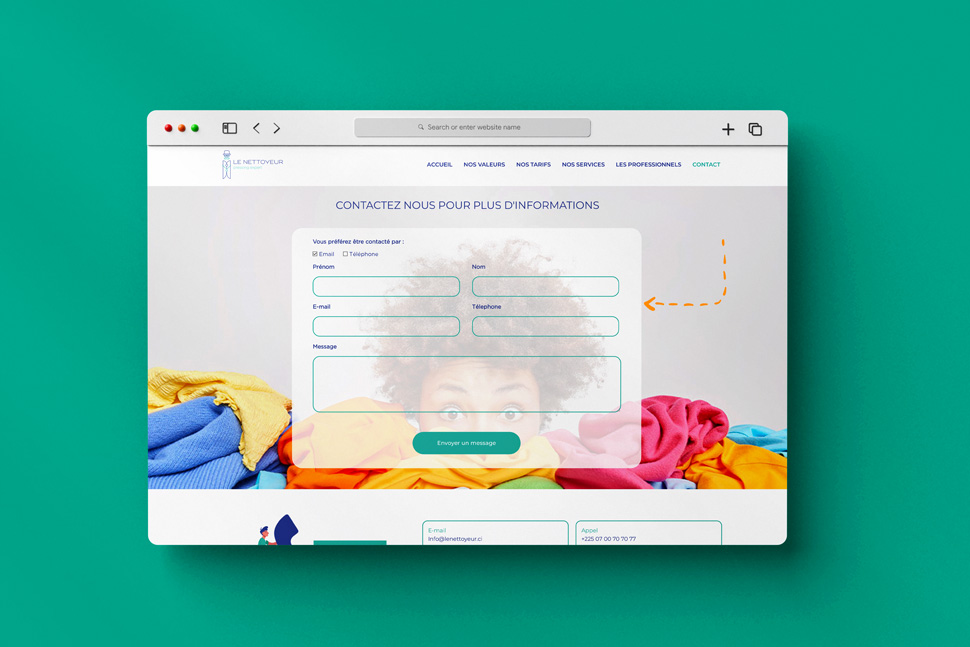
Formulaire de contact

Cette option du site web est bifonctionnelle. Elle donne la possibilité au client d'envoyer directement un message au pressing le Nettoyeur et lui permet également de choisir le canal par lequel il souhaiterait être contacté, soit par mail ou soit par appel téléphonique.
La réalisation

Conformément aux attentes du pressing Le Nettoyeur, l’agence Comfordev, après analyses et études a su proposer un site web répondant à leur besoin. Chaque détail du projet a été pensé et délicatement choisi dans le but de satisfaire son client et d’être dans sa vision. Ce qui a valu la validation du site web développé et une très grande satisfaction du pressing. Plus que le but, tel est l’objectif de l’agence Comfordev.


Allez, c’est parti !

Visiter le site

Démarrez ici

Demander devis